The 50/30/20 Budget Rule Explained (With Real Examples)
 The FreeBudget Team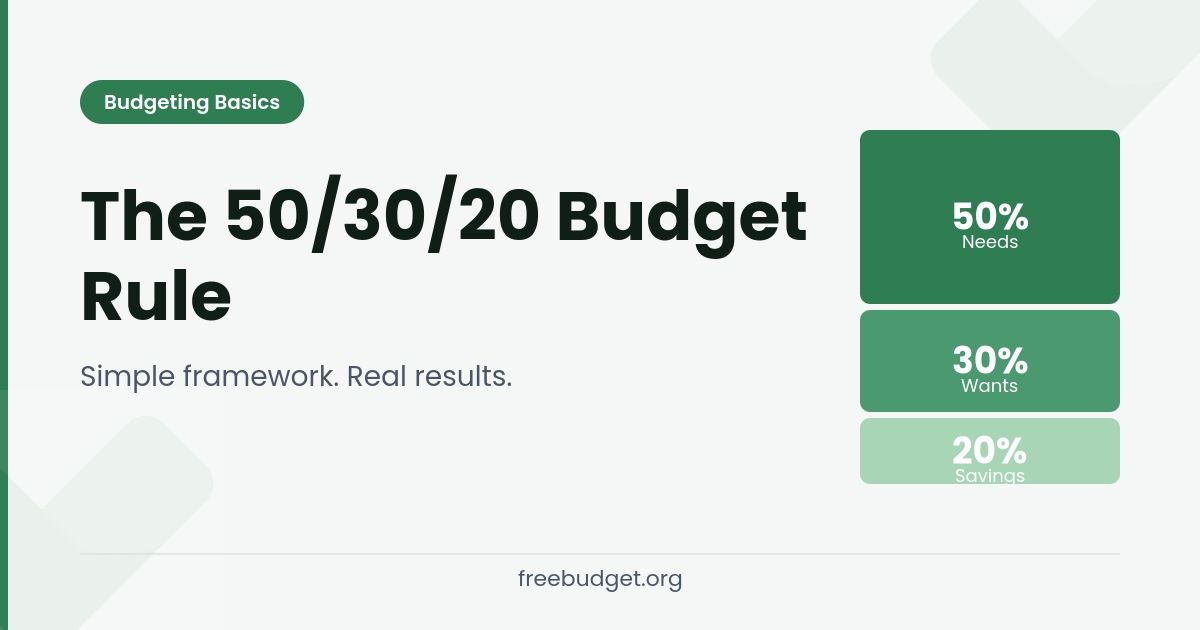
Most people who struggle with money aren't bad at math. They just don't have a system. The 50/30/20 rule is one of the simplest systems that actually works, and you can apply it to your finances in about ten minutes.
Here's what it is, how to use it, and when it doesn't fit (because no rule fits everyone perfectly).
What the 50/30/20 Rule Is
The 50/30/20 rule divides your after-tax income into three buckets:
- 50% goes to needs
- 30% goes to wants
- 20% goes to savings and debt paydown
That's it. Three numbers, one framework. The rule has been around since the early 2000s as a personal finance guideline, and it's held up because it's simple enough to remember and flexible enough to actually work for most people.
The core idea: if you can keep your spending roughly within these ratios, you'll cover your essentials, still enjoy your life, and build financial security at the same time. No spreadsheet required (though we'll show you how to track it if you want to).
Breaking Down Each Category
Needs (50%)
Needs are expenses you can't skip without serious consequences. Think of them as the bills that would cause immediate problems if you stopped paying them.
What counts as a need:
- Rent or mortgage payments
- Utilities (electricity, water, heat)
- Groceries (basic food, not DoorDash)
- Health insurance and essential medications
- Minimum debt payments (credit cards, student loans)
- Transportation to work (car payment, gas, or transit fare)
- Basic phone plan
- Childcare if it's required for you to work
What does not count as a need, even if it feels like one:
- Streaming subscriptions
- Gym memberships
- Dining out
- Premium phone plans when a basic one would do
- Amazon Prime and similar convenience subscriptions
The line between need and want is genuinely blurry in practice. A car payment might be a need if you live somewhere with no public transit. A gym membership might feel essential to your mental health. The rule doesn't require you to be miserable. It just asks you to be honest with yourself about what you'd actually lose if you cut something.
If you're unsure whether something is a need or a want, ask: would skipping this for one month cause a real problem (late fees, job loss, health consequences)? If yes, it's probably a need. If it would just be annoying or less comfortable, it's a want.
Wants (30%)
Wants are things you spend money on by choice. They make life better but aren't survival-critical.
- Restaurants and takeout
- Streaming services (Netflix, Spotify, etc.)
- Hobbies and entertainment
- Clothes beyond basic necessities
- Travel and vacations
- Subscriptions you could live without
- Upgrades (nicer car, bigger apartment than you actually need)
- Coffee shop drinks, convenience purchases, impulse buys
The 30% category is where most people see the most opportunity. It's also where lifestyle creep lives. When your income goes up, wants tend to expand to fill the available space, often without you noticing. A raise becomes a nicer apartment, a streaming upgrade, a habit of eating lunch out every day. Three years later, you're earning more and saving roughly the same percentage as before.
Tracking your wants spending is usually the most eye-opening part of doing this exercise for the first time. Most people find their wants are running significantly higher than 30%.
Savings and Debt (20%)
This category covers building your future and unwinding your past. It includes:
- Emergency fund contributions (target: 3 to 6 months of expenses)
- Retirement contributions (401k, IRA, Roth IRA)
- Brokerage or investment accounts
- Extra debt payments above the minimum
- Saving for specific goals (house down payment, car, wedding, etc.)
One important note: minimum debt payments go in the needs category since you have no real choice about paying them. Extra payments above the minimum belong here in the savings bucket, because those are discretionary choices that build your financial position over time.
If you're just starting out, prioritize in this order:
- Get your employer's 401k match first. That's an instant 50-100% return on that money.
- Build a $1,000 starter emergency fund.
- Pay down high-interest debt (anything above 7-8%).
- Build your emergency fund to 3-6 months of expenses.
- Then invest the rest.
Real Numbers: What 50/30/20 Looks Like at Different Incomes
Let's make this concrete. These examples use monthly take-home pay (after taxes and any pre-tax 401k contributions).
Take-home: $3,500/month
- Needs (50%): $1,750 (rent, groceries, utilities, car, insurance)
- Wants (30%): $1,050 (dining out, subscriptions, entertainment, clothing)
- Savings/debt (20%): $700 (emergency fund, extra student loan payments)
Take-home: $5,500/month
- Needs (50%): $2,750 (mortgage or rent, car, insurance, utilities, groceries)
- Wants (30%): $1,650 (travel, dining, hobbies, streaming, home decor)
- Savings/debt (20%): $1,100 (maxing Roth IRA contribution, investing the rest)
Take-home: $8,000/month
- Needs (50%): $4,000 (mortgage, two cars, family groceries, utilities, insurance)
- Wants (30%): $2,400 (vacations, restaurants, kids' activities, subscriptions)
- Savings/debt (20%): $1,600 (retirement, college savings, taxable investment account)
The math is simple. The hard part is knowing what your actual numbers are, which requires looking at real transaction history rather than guessing.
A Full Worked Example
Here's what this looks like for a real person. Let's call her Sarah. She takes home $4,800 a month after taxes.
Her targets:
- Needs: $2,400
- Wants: $1,440
- Savings: $960
Her actual spending last month:
- Rent: $1,350
- Groceries: $380
- Car payment: $290
- Car insurance: $140
- Phone: $85
- Utilities: $120
- Minimum credit card payment: $75
- Needs total: $2,440 (just over target, 51%)
- Dining out: $420
- Streaming (Netflix, Hulu, Spotify, Apple TV+): $62
- Gym membership: $45
- Shopping (clothes, Amazon impulse buys): $310
- Weekend activities and concerts: $190
- Coffee shops: $95
- Wants total: $1,122 (under target, 23%)
- Extra credit card payment: $0
- Emergency fund transfer: $200
- Roth IRA contribution: $0
- Savings total: $200 (way under target, 4%)
What does this tell Sarah? Her needs and wants look reasonable on paper, but her savings rate is way off. The issue isn't that she's overspending on fun. It's that she stopped at the minimum credit card payment and only transferred a small amount to savings. The other $1,038 that month went... somewhere. Probably to small purchases that didn't feel significant in the moment.
This is why tracking matters. Most people think they know where their money goes. The actual data is almost always different from the mental model.
Where the 50/30/20 Rule Works Best
The 50/30/20 rule works well when your income is stable and your needs stay under 50%. It gives you a clear, low-stress framework that doesn't require tracking every single transaction.
It's particularly useful if you're:
- New to budgeting and want a starting point
- Generally responsible with money but want a sanity check on your ratios
- Earning a solid income where 50% actually covers your needs
- Already saving something but want a benchmark to measure against
The rule is also flexible. You're not expected to hit these ratios exactly every month. Think of them as targets, not hard limits. If your wants run to 35% one month because you took a vacation, that's fine. The goal is the long-run average, not perfection in any given month.
Where the 50/30/20 Rule Breaks Down
The rule doesn't work for everyone, and it's worth knowing why before you try to force it to fit.
High cost-of-living areas. In New York City, San Francisco, or Boston, rent alone can eat 40 to 50% of a moderate income. Add groceries, transportation, and utilities, and you're already over 50% on needs before you've bought a single want. If you live somewhere expensive, 50% for needs may simply not be achievable. Some people adjust to 60/20/20 or even 70/20/10 to reflect their reality. That's okay. Adjusting the percentages doesn't mean the framework fails. It means you're being honest about your situation.
Lower incomes. If you're earning $32,000 a year after taxes, basic needs might consume 65 or 70% of your take-home. The rule was designed for people with enough breathing room that 50% actually covers necessities. If your income is tight, zero-based budgeting (assigning every dollar to a specific job) often works better than a percentage system, because it forces clarity on every single spending decision rather than working at the category level.
Heavy debt loads. If you're carrying significant student loans, medical debt, or high-interest credit card balances, the 20% savings bucket might need to go almost entirely toward debt paydown for a while. That's fine. The rule is a guideline. Paying off a 24% APR credit card gives you a guaranteed 24% return, which is better than almost any investment. Prioritize that.
Variable income. Freelancers, commission-based workers, and gig workers find percentage-based rules harder to apply when income swings month to month. In those cases, tracking absolute spending levels and building a larger buffer matters more than hitting ratios. Some variable-income earners base their budgets on their lowest recent month of income and invest everything above that.
Common Mistakes People Make
Using gross income instead of take-home. The 50/30/20 percentages apply to your after-tax income, not your salary. If you make $75,000 a year, your take-home might be closer to $55,000 depending on your tax situation and pre-tax deductions. Use the number that actually hits your bank account.
Classifying wants as needs. This is the most common error. Netflix is not a need. A gym membership is not a need. A new iPhone every year is not a need. Be rigorous about this, at least when you first run the numbers, because the whole point is to see clearly where your money is actually going.
Treating the 20% as whatever's left. The savings category should be intentional, not a residual. If you spend 50% on needs and 35% on wants, there's only 15% left for savings. That's not the rule working. That's the rule telling you that your wants are too high.
Quitting after one month. The 50/30/20 analysis is most useful as a recurring check, not a one-time exercise. Spending patterns shift with seasons, life changes, and income fluctuations. Running the numbers quarterly keeps you honest without turning budgeting into a second job.
How to Actually Use It
Knowing the rule is the easy part. Applying it requires knowing where your money is actually going. Most people overestimate what they spend on needs and underestimate what they spend on wants.
Here's a simple process:
Step 1: Find your actual take-home pay. Not your salary. Your after-tax, after-deductions deposit. Check your bank statement or last few paychecks.
Step 2: Calculate your targets. Multiply your monthly take-home by 0.50, 0.30, and 0.20 to get your three category budgets.
Step 3: Pull your last 30 to 60 days of transactions. Most banks let you export these as a CSV file. Download it.
Step 4: Sort into the three buckets. Every transaction gets a label: need, want, or savings. You don't need to be perfect. Approximate is fine.
Step 5: See where you stand. Are you over on needs? (Common if you live somewhere expensive.) Over on wants? (Very common. Most people are.) Under on savings? (Almost universal.)
Step 6: Adjust one thing. Don't try to overhaul everything at once. Pick one category where you're furthest off and make one specific change this month.
If you want a free tool to help with this, FreeBudget was built for exactly this kind of tracking. You can connect your bank accounts directly, import transactions from a CSV export, or add them manually. Whichever fits how you work. From there you can set budget targets by category, see actual vs. planned spending side by side, and track your net worth over time. The core features are free, no subscription required. Bank sync is available as a small add-on if you want live balances without manual imports.
freebudget.org
The Bigger Picture
The 50/30/20 rule isn't magic. It's a framework for making tradeoffs visible. Before you applied it, you were still spending on needs, wants, and savings. You just didn't know what percentage each got. Naming the buckets doesn't change your spending automatically, but it does give you a target and a way to measure whether you're getting closer.
That's the whole point of any budgeting system: not to make you feel guilty about the past, but to give you better information for making decisions going forward.
If you've never tracked your spending before, the 50/30/20 rule is one of the best places to start. It's simple enough to remember, honest enough to surface real problems, and flexible enough to adapt to your actual life.
Start with last month. Pull your transactions. Sort them into three piles. See what the numbers actually say.
Most people find at least one thing that surprises them. That surprise is the whole point.