Why FreeBudget Is the Best Free YNAB Alternative in 2026
 The FreeBudget Team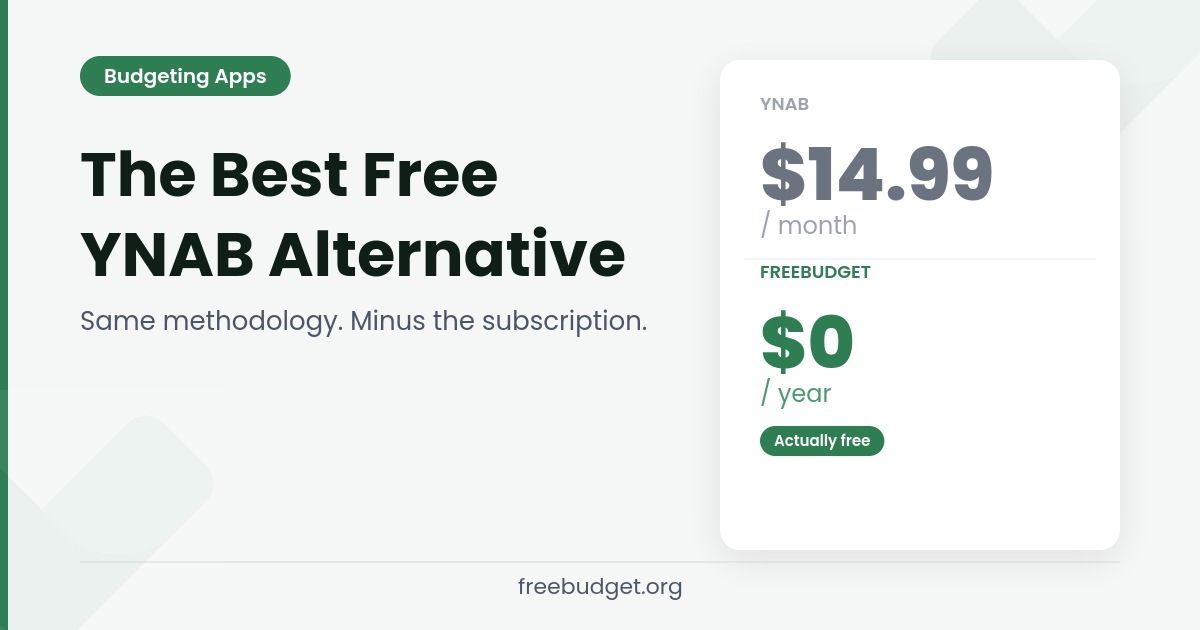
YNAB is genuinely one of the best budgeting apps ever made. The methodology works, the support is excellent, and if you use it consistently, you will save money. The problem is $14.99 a month.
For people who already carry credit card debt, paying $14.99 a month for a budgeting tool feels backwards. For people just starting out and not sure they'll stick with it, committing to a monthly subscription is a real barrier.
This guide is for anyone looking for a free alternative that does not require compromises.
What Makes YNAB Worth Paying For
Before getting into alternatives, it's worth understanding what YNAB actually does well. You cannot evaluate an alternative without knowing what you're comparing against.
YNAB's core methodology is zero-based budgeting: every dollar of income gets assigned a job before the month starts. Nothing floats. Unassigned money creates bad habits; assigned money creates intentional spending.
The four rules YNAB teaches are genuinely good personal finance principles:
- Give every dollar a job
- Embrace your true expenses (save for irregular costs)
- Roll with the punches (adjust your budget, do not abandon it)
- Age your money (work toward spending last month's income)
This methodology works. The app is polished, the support team is real humans who know the product, and the YNAB community is one of the best personal finance communities on the internet.
If you love YNAB and can afford it, keep using it. This article is not arguing that YNAB is bad. It is arguing that $14.99 a month is not the only path to getting your budget under control.
Why People Look for YNAB Alternatives
The most common reason is the price. At $14.99/mo, YNAB is a meaningful ongoing expense. For someone paying off debt or building their first emergency fund, that monthly line item is real money.
The second reason: people want to try zero-based budgeting before committing to a subscription. If you have never budgeted before, paying to learn if it even works for you is a tough ask.
The third reason: life changes. Maybe you used YNAB for years, it worked great, and now you are looking for something simpler or less expensive.
Whatever the reason, here's what the alternatives actually look like.
The Most Common Free YNAB Alternatives (And Their Tradeoffs)
Actual Budget is an open-source, self-hosted budgeting app. It is genuinely powerful and the methodology is close to YNAB's. The tradeoff: you have to run it yourself, which means setting up a server or using a third-party host. Not difficult if you are technical, but a real barrier for most people.
Google Sheets with a YNAB template is effective if you are disciplined, but fragile. Templates break, manual entry gets tedious, and there is no real mobile experience. Most people abandon it within two months.
EveryDollar is Dave Ramsey's budgeting app. The free tier is limited to manual entry only, and the paid tier ($79.99/yr) is still not cheap. The methodology is similar to YNAB but the free version is stripped down.
Goodbudget uses envelope budgeting with a free tier (10 envelopes, 1 account). It works, but the tier limits make it difficult to use as a full budgeting solution for most households.
Empower (formerly Personal Capital) is more of an investment and net worth tracker than a budgeting tool. The budgeting features are basic and the product is primarily designed to upsell wealth management services.
What Actually Makes FreeBudget Different
FreeBudget takes a different position: free to use for everything that matters, with one optional paid add-on for live bank connections. You can use it for zero-based budgeting if that's the approach you want, or set it up however works for your situation.
Here is what you get for free:
Full budget management. Create categories, set spending limits, and track actuals against your budget in real time. Whether you assign every dollar or just track spending by category, the tool adapts to your approach.
Transaction import via CSV. Every major bank lets you export transactions as a CSV file. Import them into FreeBudget in seconds and they auto-categorize. No manual entry required.
Net Worth tracking. Connect all your accounts (assets and liabilities) and watch your net worth trend over time. Not a paid add-on.
Reporting. Monthly spending breakdowns, category analysis, income vs. expense trends. Also free.
Progressive Web App. Works on any device with a browser. No download required. Install it to your home screen and it runs like a native app on iOS, Android, or desktop.
The one paid feature is bank sync: connecting directly to your financial institutions so transactions import automatically. That costs $0.99/mo for up to 2 accounts, plus $0.50/mo per additional account. It covers the data connection costs. If you prefer to pull transactions manually via CSV, that path is completely free.
How FreeBudget Compares to YNAB on the Things That Matter
Approach: YNAB is built specifically around zero-based budgeting and their four-rule system. FreeBudget is more flexible. It supports zero-based budgeting if that's what you want, but it does not enforce a specific method. You can customize it to fit how you actually think about money.
Price: YNAB costs $14.99/mo. FreeBudget is free. Bank sync is optional at $0.99/mo.
Setup: Create an account, import a CSV or connect a bank, start budgeting. No tutorial you have to sit through. YNAB has more structured onboarding, which some people find helpful and others find slow.
Mobile: Both work on mobile. YNAB has native iOS and Android apps. FreeBudget is a Progressive Web App that installs to your home screen and behaves like a native app.
Support: YNAB has a dedicated support team and one of the best budgeting communities on the internet. FreeBudget is a smaller, newer product, so the community is still growing.
Where YNAB wins: The educational layer. YNAB has years of courses, videos, blog posts, and live workshops built around their methodology. If you are brand new to budgeting and want to be guided through every step, YNAB's support infrastructure is excellent. FreeBudget assumes you know roughly what you are trying to do and just need the tool to do it.
Who Should Use FreeBudget Instead of YNAB
FreeBudget makes the most sense if:
You are new to budgeting and not sure if you will stick with it. Try budgeting for free before committing to any subscription. If it works for you, great. If not, you have lost nothing.
You are paying off debt. Spending $14.99 a month on a tool to help you save money has a certain irony to it. FreeBudget lets you redirect that money toward the debt instead.
You used Mint and have not found a replacement. Mint was free. The alternatives should not cost money. FreeBudget is the closest thing to what Mint offered in terms of a no-cost, full-featured personal finance tool.
You prefer CSV imports. If you like pulling transactions manually and reviewing them yourself before they land in your budget, FreeBudget's import flow is fast and clean.
The Bottom Line
YNAB is a great product. It is also $14.99 a month.
FreeBudget gives you a full-featured budgeting tool without the subscription. It is not a stripped-down free trial. The core features are genuinely free, with one optional paid add-on for people who want live bank connections.
If you have been putting off budgeting because the tools that work seem to cost money, that excuse does not hold anymore.
Try it at freebudget.org. No credit card. No trial period. No catch.