12 Best Personal Finance Creators to Follow in 2026
 The FreeBudget Team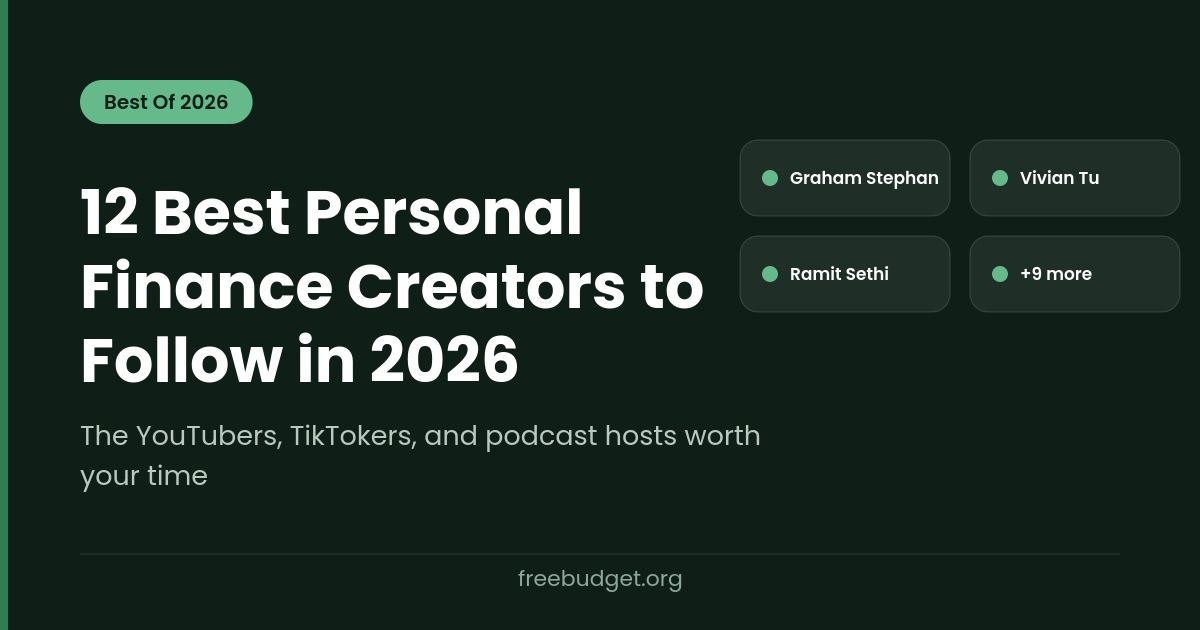
The Best Personal Finance Creators to Follow in 2026
Personal finance content on social media has a reputation problem, mostly earned. For every creator explaining compound interest clearly, there are ten selling a course about how they got rich doing exactly that.
The creators on this list have built real audiences by being genuinely useful, not by promising a shortcut. Some are analytical, some are funny, a few built their whole platform on being the person who explains things your parents never did. What they have in common is longevity: none of these are creators who blew up for one viral video and disappeared. They've been doing this for years, across multiple platform algorithm changes, which is its own kind of evidence that the content actually holds up.
Here's who's actually worth the follow in 2026.
Graham Stephan
Graham Stephan started in real estate before building one of the largest personal finance channels on YouTube, and it shows in how he talks about money: heavy on real numbers, real deals, and real estate investing, with regular breakdowns of his own spending and net worth. His day-in-the-life and expense breakdown videos in particular do a good job of normalizing the idea that you can earn well and still be deliberate about spending.
Best for: viewers who want real estate and investing content anchored in specific numbers rather than generalities.
Humphrey Yang
Humphrey Yang built his following by taking genuinely complicated topics, tax brackets, the difference between a Roth and traditional IRA, how inflation actually works, and explaining them in a minute or less without dumbing them down. He's one of the more prolific creators on this list, publishing across YouTube, TikTok, and Instagram, and the short-form format forces a clarity a lot of longer finance content lacks.
Best for: viewers who want quick, accurate explainers rather than long-form deep dives.
Andrei Jikh
Andrei Jikh's background is in magic, literally, he was a professional magician before finance content, and that showmanship shows up in how watchable his videos are even when the topic is something as dry as dividend investing or Roth conversions. He's also more willing than most to walk through his own portfolio and mistakes in detail.
Best for: viewers who want investing content with genuinely high production value.
Vivian Tu (Your Rich BFF)
Vivian Tu spent years as a trader on Wall Street before becoming Your Rich BFF, and the pitch is right there in the name: finance advice delivered like a knowledgeable friend, not a lecture. She's become one of the most recognizable finance creators on TikTok and Instagram, especially for viewers who found traditional finance media alienating or overly technical.
Best for: viewers who want investing and career money advice without the jargon.
Tori Dunlap (Her First $100K)
Tori Dunlap built Her First $100K around a specific mission: closing the gender wealth gap by giving women concrete, unapologetic financial advice. The content spans investing basics, salary negotiation, and the specific ways financial advice historically underserved women, delivered with a directness that resonated enough to become a bestselling book and a large cross-platform following.
Best for: viewers who want financial independence content built specifically around women's financial challenges.
Ramit Sethi
Ramit Sethi has been doing this longer than almost anyone on this list, his book "I Will Teach You To Be Rich" first came out in 2009, and his newer Netflix series and podcast have introduced his approach to a much larger audience. Sethi's core idea is that most financial advice fixates on small savings, canceling a subscription, skipping coffee, instead of the big wins: negotiating salary, automating investments, and being deliberate about what he calls your "money dials," the handful of things you actually love spending on.
Best for: viewers who want a structured, systems-based approach rather than piecemeal tips.
Dave Ramsey
Love him or disagree with parts of his approach, Dave Ramsey has probably influenced more people's relationship with debt than any other personal finance figure of the last three decades. His radio show turned media empire built the debt snowball method into a household term, and his baby steps framework remains one of the most widely followed structured plans in personal finance, even among people who don't agree with every position he takes.
Best for: viewers who want a clear, structured, debt-first framework and don't mind a more traditional, occasionally blunt style.
Brian Jung
Brian Jung built his channel around credit cards, travel rewards, and increasingly crypto, and he's become one of the more trusted voices for viewers trying to actually understand how points and rewards programs work rather than just chasing sign-up bonuses. His breakdowns of specific card comparisons are detailed enough to be genuinely useful for a real decision.
Best for: viewers optimizing credit card rewards and travel points specifically.
Nick True (Mapped Out Money)
Nick True's channel, Mapped Out Money, focuses squarely on budgeting and the everyday decisions that make or break a household's finances, credit card strategy, tracking spending, and the mental side of sticking to a plan. It's a smaller, more personal channel than some of the others on this list, which comes through in how relatable the advice feels.
Best for: viewers who want budgeting content that feels like advice from a friend who's actually done it, not a guru.
Delyanne The Money Coach
Delyanne Barros left a career as an attorney to become a full-time financial educator, and her content focuses heavily on investing basics for beginners, especially viewers who feel like investing content usually assumes too much prior knowledge. She's particularly direct about the ways her own background, as a first-generation American, shaped a financial education she had to build from scratch.
Best for: viewers who want investing explained from true beginner assumptions, without judgment.
The Budgetnista (Tiffany Aliche)
Tiffany Aliche built The Budgetnista after losing her savings during the 2008 financial crisis, and the brand has grown into books, a bestselling budgeting course, and a large community focused on financial literacy, particularly for women and communities historically underserved by traditional financial advice. The tone is consistently encouraging rather than shaming, which is part of why the community around it has stayed so engaged for over a decade.
Best for: viewers who want budgeting and savings content with a strong community and accountability component.
Erin Lowry (Broke Millennial)
Erin Lowry started Broke Millennial as a blog before it became a book series and a broader media presence, and the throughline across all of it is talking about the money conversations people avoid: what to do when a friend owes you money, how to talk about finances with a partner, how to negotiate without feeling awkward about it. The advice is less about spreadsheets and more about the genuinely uncomfortable social side of money that most financial content skips entirely.
Best for: viewers who want help with the interpersonal side of money, not just the math.
Following Creators Without Copying Their Playbook
The creators on this list disagree with each other constantly. Dave Ramsey would tell you to avoid credit cards entirely; Brian Jung's entire channel is built around using them well. Ramsey preaches debt avoidance above almost everything else; Graham Stephan leverages debt regularly to buy real estate.
That's not a reason to dismiss any of them, it's the reason to follow more than one. Personal finance advice is downstream of the person giving it: their risk tolerance, their starting point, what actually worked for them. The goal isn't to find the one creator with the objectively correct answer. It's to hear enough different, credible perspectives that you can build a version of "good financial advice" that actually fits your life, instead of copying someone else's playbook that happened to work for their specific situation.
The hardest part of following any of these creators isn't understanding their advice, it's knowing whether it's actually working for your specific numbers. Ramsey's baby steps, Ramit's money dials, Graham's spending breakdowns, all of it requires actually seeing your own transactions and net worth clearly, not just believing you're doing better. FreeBudget exists for that part, a free way to track spending and net worth so you can tell if the framework you just adopted is actually moving the needle.
freebudget.org