Debt Avalanche vs Debt Snowball: Which Method Actually Gets You Out of Debt Faster?
 The FreeBudget Team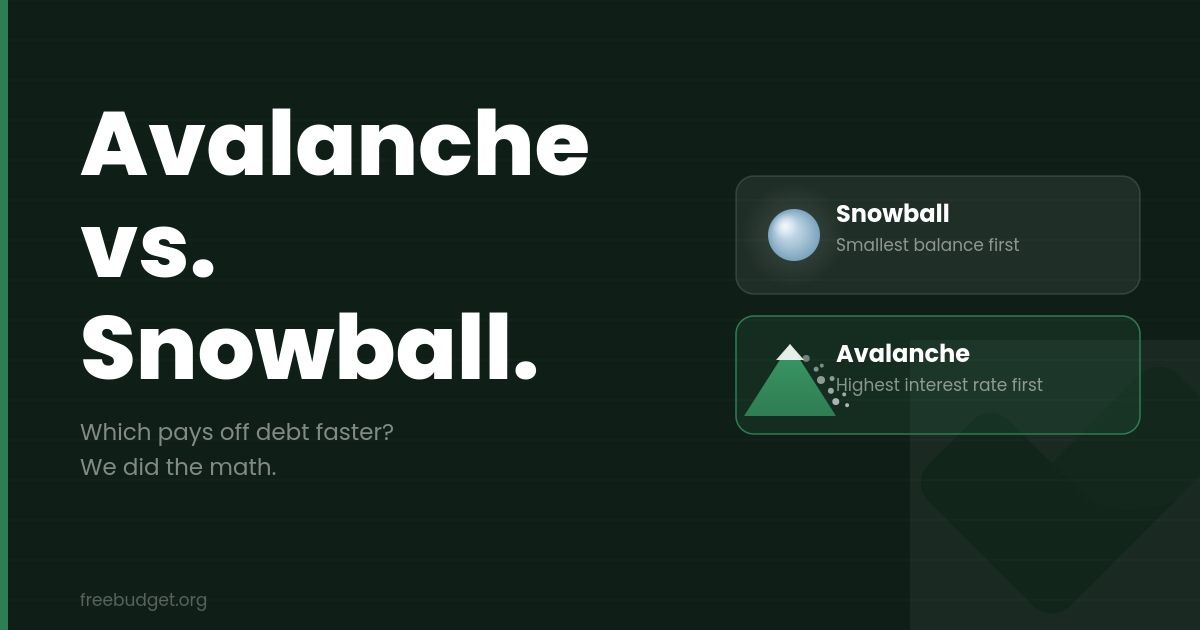
You've got multiple debts. Credit card at 24% APR, car loan at 7%, student loans at 5.5%. You have an extra $300 a month to throw at them. Where does it go?
This is the avalanche vs snowball question, and the personal finance world has been arguing about it for decades. The argument is usually framed as math people versus feelings people. That framing is wrong, and it leads a lot of people to pick the wrong method for them.
Here's how both methods actually work, what the research says, and how to decide.
The Debt Avalanche Method
With the avalanche method, you pay minimum payments on every debt, then put every extra dollar toward the debt with the highest interest rate. When that debt is gone, you roll the freed-up minimum payment onto the next highest rate. You repeat until you're debt-free.
The logic is purely mathematical. High interest rates mean more of your payment goes to interest rather than reducing principal. By targeting the highest rate first, you minimize total interest paid over time.
Here's what that looks like with a real example:
Debt A: $5,000 balance, 24% APR, $150 minimum payment
Debt B: $8,000 balance, 7% APR, $200 minimum payment
Debt C: $3,000 balance, 5.5% APR, $90 minimum payment
Total minimum payments: $440/month. You have $300 extra, so you're paying $740/month total.
With avalanche: you throw all $300 extra at Debt A (the 24% card). Once it's gone, that $450/month ($150 minimum plus your $300 extra) gets rolled onto Debt B. Then everything rolls onto Debt C.
Result: You pay off all three debts in roughly 29 months and pay about $3,200 in total interest.
The Debt Snowball Method
With the snowball method, you pay minimum payments on every debt, then put every extra dollar toward the debt with the smallest balance. When that debt is gone, you roll the freed-up payment onto the next smallest balance. Same rolling mechanic, different target.
Using the same example:
Debt A: $5,000 balance, 24% APR, $150 minimum
Debt B: $8,000 balance, 7% APR, $200 minimum
Debt C: $3,000 balance, 5.5% APR, $90 minimum
With snowball: you throw all $300 extra at Debt C first (the smallest balance). Once it's gone, $390/month ($90 minimum plus $300 extra) goes toward Debt A. Then everything toward Debt B.
Result: You pay off all three debts in roughly 31 months and pay about $3,900 in total interest.
The avalanche saves you about $700 and gets you out of debt two months faster in this example. The gap widens with larger balances and bigger rate differences.
So end of article, right? Avalanche wins.
Not quite.
Why the Snowball Actually Works Better for Most People
In 2012, researchers at Northwestern's Kellogg School published a study in the Journal of Marketing Research on how people actually pay off debt. They found that people who concentrated payments on their smallest balance made more progress and were more likely to eliminate their total debt than people who spread payments across balances or targeted high-interest debt.
A follow-up study from Harvard Business Review found the same thing: people using the snowball method were more likely to become debt-free, even though they paid more in interest.
The reason: motivation. Paying off a debt completely feels different than chipping away at a large one. Every time you eliminate a balance, the number of accounts you're juggling shrinks. You get a win. You see progress. You keep going.
With the avalanche method targeting a large, high-rate credit card, you might be making payments for 18 months before anything disappears. For a lot of people, that's 18 months of paying into what feels like a void. The method is mathematically optimal but psychologically brutal.
This is not a knock on math or discipline. It's just how humans work. We respond to visible progress. We like finishing things. The snowball method is designed around that reality.
When the Avalanche Actually Wins
There are real situations where the avalanche is the better choice.
If your highest-interest debt is also your smallest balance, both methods point at the same debt. Pick the avalanche, you'll be done faster anyway.
If the interest rate gap between your debts is enormous, say 28% versus 6%, the interest savings can be substantial enough that it's worth prioritizing mathematically. Thousands of dollars, not hundreds.
If you have strong natural motivation to get out of debt regardless of method, a clear goal, a track record of following through, the behavioral edge of the snowball may not matter for you.
If your high-interest debt has a large balance that will take years to pay off either way, tackling it first means years of high interest accruing on a balance you're slowly grinding down. The math compounds in the avalanche's favor the longer it takes.
When the Snowball Actually Wins
If you've tried to pay off debt before and abandoned the plan, the snowball is a serious consideration. Early wins matter more than optimized math if the alternative is quitting.
If you have a lot of accounts, say five or six separate debts, eliminating the smaller ones quickly reduces the mental overhead of tracking multiple minimum payments. Fewer accounts is simpler, and simpler is more sustainable.
If the psychological weight of debt is affecting your day-to-day mood or decision-making, the quick wins can shift your relationship with the whole process. Debt payoff stops feeling like a slog and starts feeling like a game you're winning.
If the interest rate differences between your debts are relatively small, say 8% versus 12%, the dollar gap between avalanche and snowball is modest. In that case the behavioral advantage of snowball is worth more than the small interest savings from avalanche.
The Hybrid Approach
Some people use a hybrid: snowball to eliminate one or two small debts quickly for the early win, then switch to avalanche to attack the high-rate balances. This isn't as clean, but it's a legitimate approach if you need the initial motivation hit before settling into the long game.
The important thing is that you pick one and execute it consistently. A good plan followed is worth more than a perfect plan abandoned.
Running the Numbers for Your Situation
The difference between avalanche and snowball depends entirely on your specific debts. With some debt profiles, the interest savings from avalanche are minimal, maybe $200-400 over the payoff period. With others, they're significant.
Before deciding, it's worth running your actual numbers. List every debt with its balance, interest rate, and minimum payment. Calculate how long each method takes to pay everything off and how much total interest you'll pay.
Most people have never done this calculation. Just seeing the numbers laid out changes how you think about the problem. Debt that felt abstract becomes concrete. The payoff date stops being some vague future event and becomes a specific month on a calendar.
How FreeBudget Fits In
Once you've chosen a method, you need a place to track it. Knowing your strategy matters less than executing it consistently, and execution requires visibility.
Use our dedicated loan tracking feature where you can manually track every loan and watch the balances get paid down over time. Every payment is reflected in the balance, and the progress is right there in your dashboard.
The Real Answer
Debt avalanche is mathematically optimal. Debt snowball is psychologically resilient. Both beat not having a method.
If you're genuinely unsure which to pick: run the actual numbers for your situation. If the interest difference is small, go snowball. If the interest difference is large and you trust yourself to stay the course, go avalanche. If you have any doubt about your ability to stay motivated through a long payoff period, go snowball.
The goal is to be debt-free, not to be technically correct about methodology while still carrying balances.
Figure out the numbers at freebudget.org. Free to use, no credit card required.