How to Stop Living Paycheck to Paycheck: A Real Budget for People Who Think Budgeting Won't Work for Them
 The FreeBudget Team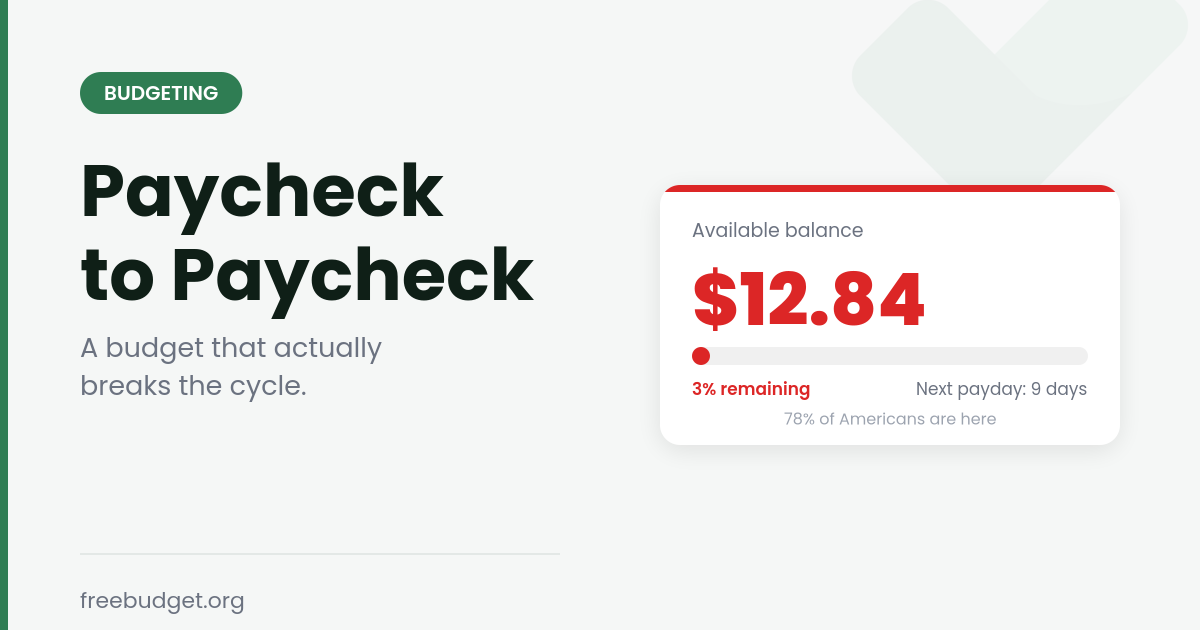
78% of Americans report living paycheck to paycheck.
Read that again. Not 30%. Not half. Nearly eight out of ten people are one bad month away from being unable to cover a basic bill.
Here's the part that doesn't get talked about enough: most of these people have tried budgeting. They've downloaded the apps. They've made the spreadsheets. They've set the spending limits. And then life happened, the system fell apart, and they concluded that budgeting just doesn't work for people like them.
But the problem isn't discipline. And in most cases, it isn't even income.
The problem is that most budgeting advice skips the one step that actually matters first.
Why Most Paycheck-to-Paycheck Advice Doesn't Work
Search for paycheck to paycheck tips and you'll find the same list everywhere: cook at home more, cancel unused subscriptions, make coffee at home, cut back on eating out.
This advice isn't wrong. It's just useless without context.
Telling someone to cut back on dining out when they don't know how much they're actually spending on dining out is like telling someone to lose weight without telling them what they're eating. You can't manage what you can't see.
The second problem with most advice is that it treats all paychecks as equivalent. Someone earning $35,000 a year in a high cost of living city and someone earning $80,000 a year in a low cost of living city can both live paycheck to paycheck for completely different reasons. Generic advice helps neither of them.
The third problem: most budgeting systems ask you to predict the future before you understand the present. They say, here's a template, fill in how much you want to spend in each category. But if you've never tracked your spending honestly, those numbers are just guesses. And guesses make budgets that feel like fiction after two weeks.
The Step Most Budgets Skip
Before you set a single spending limit, you need 30 days of truth.
Not 30 days of better behavior. Not 30 days of cutting back. Thirty days of watching where your money actually goes right now, with zero judgment and no targets to hit.
This is the step almost nobody takes because it feels passive. People want to fix things immediately. But you can't build a budget that works for your real life if you don't know what your real life costs.
Here's what you do:
For the next 30 days, track every transaction. Not in your head. Somewhere you can actually see it. A spreadsheet, a budgeting app, a notes app on your phone. Every purchase, every bill, every subscription charge. You're not grading yourself. You're collecting data.
At the end of 30 days, you'll know your number. The real one. Not the one you estimated. The actual amount your life costs right now.
For most people, this number is surprising. Sometimes it's more than expected. Often, specific categories are dramatically higher than assumed. Almost everyone underestimates dining out and subscriptions.
Step 1: Find Your Real Income Number
This sounds obvious but gets missed constantly.
Your budget should be based on take-home pay, not gross income. Not your salary. The number that actually lands in your bank account after taxes, health insurance premiums, 401k contributions, and any other deductions.
If you're paid bi-weekly, take your net paycheck amount and multiply by 26, then divide by 12. That's your monthly budget ceiling.
If your income varies month to month, use the average of your last three months of deposits. Not your best month. The average.
Everything else in your budget flows from this number. It's the ceiling. You can't spend more than what lands in your account, and anything that claims otherwise is just debt dressed up as income.
Step 2: Map What You Actually Owe Every Month
Before you budget a single discretionary dollar, write down every fixed obligation you have. These are the amounts that hit every month regardless of what you do:
- Rent or mortgage
- Car payment
- Insurance (auto, health, renters or homeowners)
- Minimum debt payments (student loans, credit cards)
- Utilities with relatively consistent amounts
- Phone
- Internet
- Any subscription you'd consider non-negotiable
Add these up. This is your floor: the amount that goes out no matter what.
For most people, fixed obligations eat 50 to 65% of take-home pay before they've bought a single grocery item. That's not unusual. That's just expensive to exist.
Now subtract your floor from your take-home income. The number left is what you actually have to work with for everything else.
Step 3: Categorize the 30 Days of Spending
Go back to that 30 days of tracking data. Sort every transaction into categories:
- Groceries
- Dining and takeout
- Gas and transportation
- Entertainment (streaming, events, apps)
- Shopping and clothing
- Health and personal care
- Miscellaneous
Don't overthink the categories. The point is to see patterns, not create a perfect taxonomy.
Look at the total for each category. Most people find at least one category that's dramatically higher than expected. That's not a character flaw. That's the data telling you something.
Note which categories feel genuinely necessary versus which ones are habits you're barely aware of. The $6 daily coffee isn't the villain it's made out to be in personal finance content. But the $12 monthly app subscription you forgot about, times eight subscriptions, adds up to nearly $1,200 a year going somewhere you didn't choose.
Step 4: Find the Gap
Here's the core equation:
Take-home income minus fixed obligations minus actual monthly spending equals your real surplus or deficit.
If the result is negative, you're spending more than you earn. This is common and fixable, but it requires an honest look at which variable expenses can actually be reduced and which ones are effectively fixed even if they don't feel that way.
If the result is zero or barely positive, the paycheck-to-paycheck feeling makes complete sense. There's no buffer. One unexpected expense (a car repair, a medical copay, a higher utility bill) wipes out whatever tiny margin exists.
If the result is meaningfully positive, the problem isn't the math. It's visibility. The money is there, but it's not being intentionally allocated, so it disappears without going anywhere useful.
All three situations are solvable. But you can't solve any of them without knowing which one you're in.
Step 5: Build a Buffer Before You Budget
The most important thing a paycheck-to-paycheck budget can do is create a small financial cushion. Not a full emergency fund. Just a buffer.
Aim for $500 to $1,000 sitting in a separate account that you don't touch. This is not your emergency fund. It's a buffer against the minor unexpected costs that turn one hard month into two hard months.
If your budget shows any surplus at all, direct every available dollar toward this buffer before doing anything else. Aggressively. Temporarily uncomfortably. Once you have $500 to $1,000 sitting there, the psychology of your finances changes. You stop being one car repair away from a bad month.
From there, your next goal is one month of fixed expenses saved. Basically, one full month of breathing room between you and your bills.
This isn't the Dave Ramsey approach or any particular system. It's just arithmetic. A buffer prevents the downward spiral where one unexpected expense becomes debt, and that debt's minimum payment becomes a new fixed obligation that makes next month even harder.
Step 6: Build the Actual Budget
Now, after 30 days of data, after mapping your obligations, after targeting your buffer, you can build a budget that might actually work.
The format is simple:
Take-home income minus savings target minus fixed obligations equals what's left for variable spending.
Allocate the variable amount across your real spending categories based on what your data showed, with intentional adjustments where you've decided to change something.
The most common mistake here: setting targets that are too aggressive. If you spent $400 dining out last month, setting a $50 target for next month isn't ambitious. It's a setup for failure. Set $300 and actually hit it. Then $250 the month after. Small wins compound.
Budgets fail when the targets are aspirational instead of behavioral. Your budget should feel like a plan, not a punishment.
The Irregular Expense Problem
One more thing most paycheck-to-paycheck budgets miss: irregular expenses.
These are the costs you know are coming but don't arrive every month. Car registration. Holiday gifts. Annual subscriptions. Home repairs. The dentist you've been putting off.
Add up your best estimate of what these cost in a year, then divide by 12. That's what you should be setting aside every month in a dedicated category, even if you don't spend it until October.
When the car needs new tires in November, if you've been setting aside $75 a month, the money is already there. No credit card. No scrambling. No debt that bleeds into next month's budget.
This one habit is the clearest separator between budgets that work and budgets that collapse after the first surprise expense.
What Actually Breaks the Cycle
Living paycheck to paycheck isn't usually a discipline problem. It's a visibility problem.
Research on financial behavior consistently shows that people who track their spending make different decisions than people who don't. Not because tracking makes them more disciplined, but because seeing the numbers changes how spending feels in the moment. A $14 lunch looks different when you know you've already spent $320 on dining this month and your budget was $250.
The 30-day tracking step at the beginning isn't just data collection. It's the start of a habit that, if maintained, is worth more than any particular budgeting template.
Check in with your numbers a few times a week. Do a monthly review. Treat the first budget as a draft, not a finished product. Adjust based on what actually happened, not what you wish had happened.
Most people who break the paycheck-to-paycheck cycle don't do it by suddenly earning more, though higher income helps. They do it by making the invisible visible, building a small buffer, and running on intentional decisions instead of whatever's left.
Tools That Help
The budgeting system matters less than consistency. That said, apps reduce friction, and less friction means higher consistency.
YNAB is the most methodologically rigorous budgeting app available. Its zero-based approach and accountability features are genuinely excellent. It costs $109 a year, which is worth it for people who use it consistently. If you're already stretched thin, that cost creates a very reasonable barrier to trying it.
Monarch Money is strong for households and couples at $99 a year. Rocket Money is solid for subscription tracking and bill negotiation at $7 to $14 a month.
FreeBudget is free. Not a trial, not freemium with most features locked. Actually free. You can import transactions directly from your bank as a CSV file, categorize spending, set budget amounts by category, and track your net worth. Bank sync (live automatic connections to your accounts) is available for $0.99 per month if you want it, but you don't need it to get started.
For someone who's paycheck to paycheck and not yet sure if budgeting will stick, starting with a free tool removes one more reason to quit.
freebudget.org. Free to start, no credit card required.