Is Monarch Money Free? Pricing, Free Trial, and Free Alternatives (2026)
 The FreeBudget Team
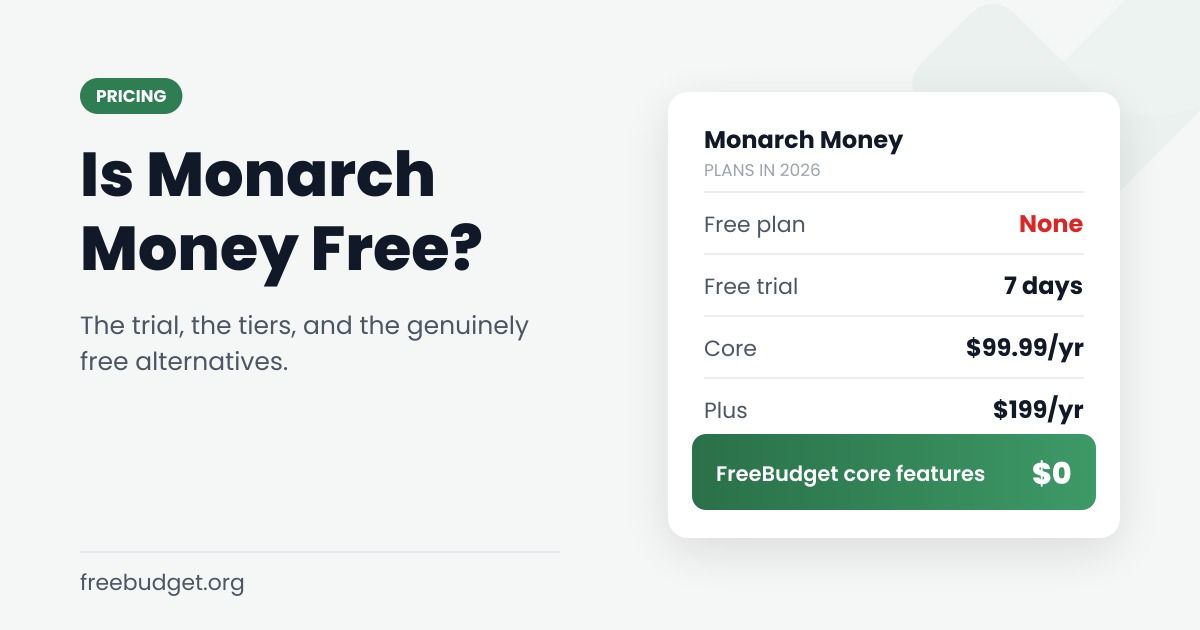
Monarch Money is not free. There's no free plan and no free tier. You get a 7-day free trial, it asks for a card before it starts, and after that it's $14.99 a month or $99.99 a year, with a Plus tier at $199 a year.
That's the whole answer, and if that's all you needed, you can close the tab. But "is Monarch Money free" is usually the first question in a longer one, which is closer to "is Monarch worth paying for, and if not, what should I use instead?" That one deserves a real answer, including the parts where Monarch is genuinely good.
Monarch Money pricing in 2026
Here's what Monarch costs right now:
- Monthly: $14.99 a month, which works out to $179.88 a year
- Annual: $99.99 a year, roughly $8.33 a month
- Plus tier: $199 a year, a newer higher tier aimed at power users
- Free trial: 7 days, card required up front
- Free plan: none
Monarch does periodically run first-year discounts, so it's worth checking their pricing page before you pay full price. But the long-run cost is the number that matters. At the annual rate, five years of Monarch is about $500. Ten years is about $1,000.
That isn't outrageous for software you use every week. It is worth knowing, though, because budgeting apps have a way of becoming one of those subscriptions you stop noticing.
Why Monarch doesn't have a free version
Monarch is refreshingly upfront about this. Their pitch is that free finance apps have to make money somewhere, usually through ads, credit card referrals, or selling products to you, and that a paid subscription means you're the customer instead of the product.
That's a fair argument. It's also exactly what happened to Mint. Mint was free for over a decade, funded largely by financial product recommendations, and when Intuit shut it down in 2024, millions of people went looking for a replacement. Monarch was one of the biggest winners of that migration, and a lot of former Mint users found it by searching almost exactly what you just searched.
So the "no free version" decision isn't Monarch being greedy. It's a business model choice with a real rationale behind it. The question is just whether that model is the only way to build an app that doesn't sell you out. (Spoiler: it isn't, but we'll get there.)
What you actually get for $99.99 a year
Monarch is one of the most polished personal finance apps available, and it's fair to say so. The standouts:
- Built for couples. Monarch lets two people share one household view with separate logins, which is the feature most reviewers point to first. If you and a partner want to manage money together in one place, it's among the best at this.
- Bank sync included. Connecting your accounts is part of the subscription rather than a separate charge.
- Investment tracking. Monarch pulls in investment accounts and shows performance and allocation, which goes beyond what most budgeting apps do.
- Goals and a clean dashboard. It's well designed and easy to look at, which matters more than people admit. You'll keep using an app you enjoy opening.
- Flexible budgeting. You can run a detailed category budget or a simpler "flex" style budget.
If those features match how you want to manage money, Monarch is a legitimately good product and $100 a year is a reasonable price for it.
When Monarch probably isn't worth it
Where people end up regretting a Monarch subscription tends to fall into a few buckets:
- You mostly want a budget, not a dashboard. If what you actually use is "how much did I spend on groceries, and how much is left," you're paying for investment tracking and collaboration features you'll rarely open.
- You're not tracking investments. Investment views are one of the features that most justify the price. Take them away and you're mostly paying a premium for design.
- Your budget is tight. There's an irony in paying $180 a year to find $180 a year. If you're budgeting because money is tight, a paid app is a real line item.
- You're fine without bank sync. Plenty of people are happy importing a CSV once a week or entering transactions by hand, and some prefer it because it forces them to look.
None of that makes Monarch a bad app. It just means the value depends on who's using it.
The genuinely free Monarch alternatives
If you've decided you don't want to pay $99.99 a year, here are the real options, including honest notes on each.
FreeBudget
This is us, so weigh accordingly. FreeBudget is a budgeting app that's free for the core features, with no trial that runs out:
- Monthly budgets by category, with budget vs. actual reports
- Shared budgets for up to five people, each with their own login and Edit or View access
- Unlimited accounts and transactions
- CSV import, so no bank connection is required
- Net worth and net income tracking
- Works on phone and desktop as a web app
The one thing that costs money is bank sync. Connecting to your bank has a small add-on fee, $0.99 a month for up to two accounts and $0.50 for each one after, which covers the connection costs. No ads, no upsells, and we don't sell your data to third parties.
Where Monarch is better: investment tracking. You can add investment accounts to FreeBudget manually and they count toward your net worth, but there's no automatic investment sync or performance analysis. Monarch's overall polish is also excellent. If those are your top priorities, that's worth knowing before you switch. We wrote a full breakdown in Monarch vs FreeBudget.
Actual Budget
Actual is open-source budgeting software built around envelope-style budgeting. The software itself is free if you host it yourself, which takes some technical comfort. There are also hosted options that charge a small monthly fee. If you like tinkering and want full control of your data, it's excellent.
Empower (formerly Personal Capital)
Empower's dashboard is free and strong on investments and net worth. Its budgeting tools are lighter, and the company's business model is wealth management, so expect to be offered advisory services. Good if you mostly care about investments; weaker as a day-to-day budget.
Free tiers of paid apps
Several apps offer a limited free version. EveryDollar has a free version where you enter transactions manually, with bank sync reserved for its paid tier. Goodbudget has a free tier with a capped number of envelopes and accounts. Both are usable, but they're designed to nudge you toward upgrading, which is fine as long as you know it going in.
A spreadsheet
Still free, still works, still what a lot of people quietly go back to. The catch is that you're the software. Every category, formula, and monthly reset is your job. If you enjoy that, it's hard to beat. If you don't, you'll stop updating it around week three.
How to decide in about two minutes
Ask yourself three questions:
- Do I want investment performance in the same app as my budget? If yes, Monarch or Empower.
- Do I care most about design and polish? Monarch is one of the nicest-looking apps in the category, and that's a fair thing to pay for.
- Is my main goal knowing where my money goes each month, alone or with a partner? If that's the core job, a free budgeting app covers it without a subscription.
If you answered no to the first two, you're mostly shopping for a budget, and there's no reason a budget should cost $100 a year.
If you're mid-trial right now
A practical tip if you've already started the 7-day trial: set a reminder for day six. Trials that need a card up front convert automatically, and "I meant to cancel" is how a lot of $99.99 charges happen. Use the week to connect your accounts, look at your real spending, and decide based on whether you actually opened the app each day, not on how nice the charts were in the first ten minutes.
And if you do pay, great. The best budgeting app is the one you'll still be using in six months, whatever it costs.
Frequently asked questions
Does Monarch Money have a free version?
No. Monarch has no free plan. New users get a 7-day free trial, after which it's $14.99 monthly or $99.99 annually for the Core plan, or $199 a year for Plus.
How long is the Monarch Money free trial?
Seven days. You need to enter a payment method to start it, and it converts to a paid plan automatically unless you cancel.
Is Monarch worth $99.99 a year?
It can be, especially if you want investments and budgeting in one polished app. If you mainly want a monthly budget, including one you share with a partner, a free app covers that job.
What's the best free alternative to Monarch Money?
It depends on what you used Monarch for. For budgeting, FreeBudget is free for core features with optional paid bank sync. For investment tracking, Empower's free dashboard is strong. For hands-on control, Actual Budget is open-source.
What happened to Mint?
Intuit shut Mint down in 2024 and pointed users toward Credit Karma. Many former Mint users moved to Monarch, which is part of why "is Monarch free" became such a common search.
We built FreeBudget because we think seeing where your money goes shouldn't come with a monthly bill, and if you want to try it without entering a card, it's waiting for you at freebudget.org.