Loud Budgeting: What the 2026 Money Trend Actually Means (and Why It Works)
 The FreeBudget Team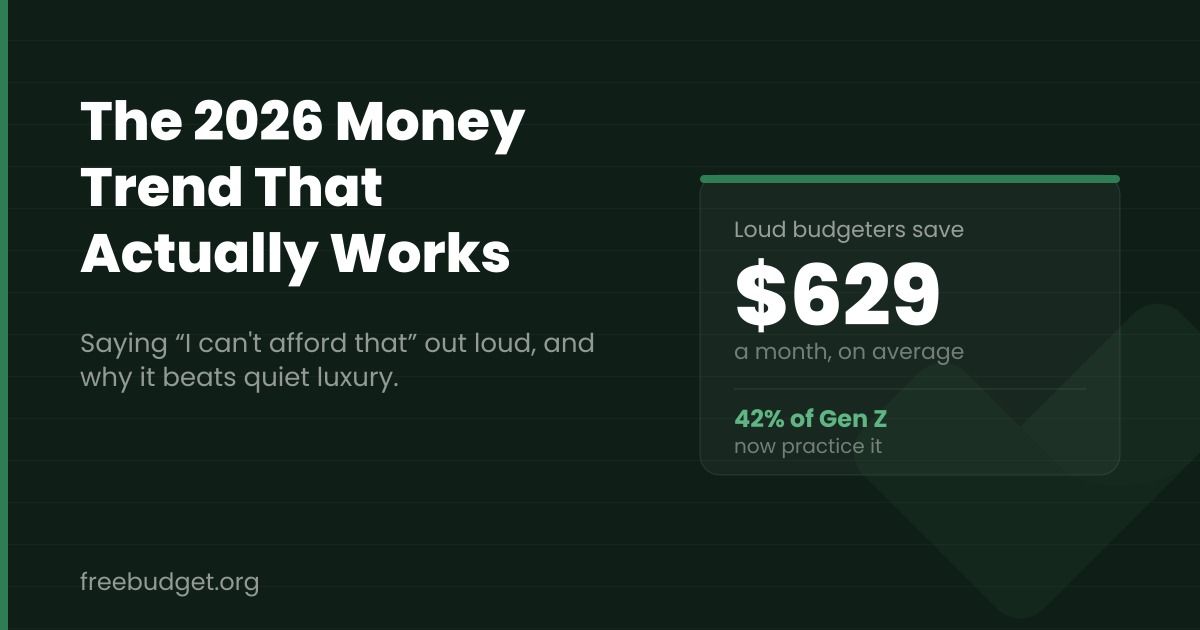
A friend invites you to a $90 dinner. Five years ago, you'd have said "I'm busy." These days, a growing number of people are saying something else instead: "I can't afford that this month, want to grab coffee instead?"
That's loud budgeting, and it's not just a TikTok bit. Research tracked by WalletHub found 42% of Gen Z now say they practice it, up from 38% just two years ago, and a YouGov consumer survey put the number even higher, 75% of Gen Z say they now take active steps to save money when they're making social plans. The trend has a name because it's a direct reaction to something specific: an entire decade of pretending we could all afford the same brunch, the same trip, the same shoes.
Where loud budgeting came from
For most of the last decade, money etiquette ran one direction: don't talk about it. You didn't mention your salary, you didn't explain why you skipped the group trip, and you definitely didn't say "that's too expensive for me" out loud in front of people who could afford it. Instead, you either went anyway and figured it out later, or you invented a scheduling conflict.
"Quiet luxury" made this worse before loud budgeting became the correction. The aesthetic of looking wealthy without saying so, unlogoed cashmere, minimalist everything, put pressure on people to perform financial comfort even when they didn't have it. Loud budgeting is the backlash: instead of quietly performing wealth you don't have, you loudly narrate the budget you actually do have.
The data backs up why the correction was necessary. A CouponCabin survey found 86% of Americans have spent money directly because of social pressure. More than half say what they see friends and strangers buying on social media pushes them to spend, often out of fear of missing out. And 63% of people admit to spending money they flat out didn't have just to show up to a social event.
That's not a rounding error. That's most people, most of the time, spending money they don't have so nobody notices they don't have it.
The real cost of staying quiet
Here's where it stops being a vibes problem and starts being a debt problem. Among people who've overspent to keep up with friends, 15% say they've racked up more than $2,000 in debt doing it. Young adults get hit hardest: 74% of 18 to 25 year olds say they've spent more than they were comfortable with just to fit in socially, and Gen Z reports financial FOMO at nearly 70%, compared to 57% for Millennials and Gen X, and 28% for Baby Boomers.
The categories where this shows up most are almost boringly predictable: dining out and travel. Not designer bags, not flashy cars. Dinner with friends. A weekend trip with the group chat. The two most social categories of spending are also the two where nobody wants to be the person who says no.
That's the mechanism loud budgeting is designed to break. If overspending happens because staying quiet feels safer than saying no, then the fix isn't a better spreadsheet. It's making "no" a normal thing to say out loud.
Does it actually work?
Surprisingly, yes, and not in a vague self-help way. In one widely cited survey, people who described themselves as loud budgeters reported saving an average of $629 a month, simply because their spending finally lined up with what they actually said their priorities were. That's not a discount or a hack. That's the entire dinner-you-skipped, trip-you-declined, subscription-you-canceled adding up once you stop hiding the decision.
There's a simple reason it works better than budgeting quietly. A private budget is a promise you make to a spreadsheet, and spreadsheets don't ask follow-up questions. A budget you say out loud is a promise you make to a person, and people remember what you told them last week. Saying "I'm not doing takeout this month" to a roommate does more to actually stop you from ordering takeout than typing the same sentence into an app nobody else reads.
This tracks with a broader shift in how people are approaching money generally. YouGov's 2026 spending survey found 53% of Americans set a budget for the year, up from 46% the year before. 76% named cost of living as their single biggest financial concern, and 54% said they're living paycheck to paycheck. People aren't budgeting more because it suddenly became fun. They're budgeting more because the margin for quietly absorbing bad financial decisions has gotten a lot thinner, and loud budgeting is one of the few money trends that's actually about spending less, not buying a new system to feel more in control.
Behavioral economists have made a version of this point for years: a commitment you say out loud to another person is harder to break than one you only make to yourself. Writing "no takeout in August" in an app is a note. Telling your roommate the same thing is a small social contract, and breaking it costs you something an app never can, the mild embarrassment of being the person who said one thing and did another. Loud budgeting isn't a new idea so much as it's an old psychological trick finally getting applied to money instead of gym attendance or diets.
It's not just a Gen Z thing
Loud budgeting gets filed as a Gen Z trend because Gen Z gave it a name and a hashtag, but the situations it solves show up at every age. It's the coworker who says "I'm skipping the Friday happy hour this month, but let's grab coffee instead" rather than quietly resenting the tab. It's the parent who tells their teenager "we're not doing a big birthday this year, here's what we're doing instead" instead of putting it on a credit card to avoid the conversation. It's the wedding guest who says "I can come to the ceremony but I can't do the destination bachelorette" instead of either draining a savings account or ghosting the group chat entirely.
Wedding season and the holidays are where this gets tested hardest, because the social cost of saying no feels highest exactly when the financial cost is also highest. A destination wedding, a white elephant exchange with a $50 minimum, a work gift exchange, a friend's milestone birthday dinner at a restaurant you'd never pick yourself, these are the moments loud budgeting was built for. "I'd love to celebrate with you, here's what works for my budget" does more for a friendship long term than showing up broke and quietly annoyed does.
There's also a quieter version of this that doesn't involve saying anything to anyone else at all: being loud with yourself. Actually looking at what a month of "keeping up" spending cost, instead of feeling generally bad about money without ever seeing the number. A lot of people who start loud budgeting say the hardest conversation wasn't with their friends, it was admitting to themselves how much the silence had been costing.
How to actually practice it
Loud budgeting isn't a personality, it's a handful of specific sentences you get comfortable saying out loud. A few that work:
- "That's not in my budget this month" instead of inventing a conflict
- "Can we do something cheaper?" instead of silently declining and hoping they don't ask again
- "I'm saving for [specific thing]" instead of a vague no that invites more questions
- "I can do X but not Y" instead of an all-or-nothing yes or no
- Telling one person, a partner, a roommate, a close friend, your actual number for a specific goal, so someone besides you knows what you're working toward
Notice what's missing from that list: shame, lecturing, or announcing your budget to everyone you know. Loud budgeting works because it's specific and low drama, not because it's a public performance of financial discipline. The goal is one honest sentence in the moment it matters, not a monologue.
It also isn't about judging the people who don't do this. Plenty of very financially secure people never say a word about their budget and are completely fine. The point isn't that silence is wrong. It's that silence has historically been the default even for people it was quietly costing money, and now there's a real, normalized alternative. And it tends to spread once someone starts: the first person to say "that's out of my budget" in a friend group usually isn't the last. It gives everyone else permission to say the same thing they'd been thinking.
The irony nobody talks about
Here's the part of this trend that's a little funny if you sit with it. Loud budgeting is fundamentally about being transparent with the people around you about money. And millions of the people practicing it are paying $109 a year for an app just to track it privately.
That's not a knock on those apps. Some of them are genuinely well built, and a lot of people are happy to pay for the polish. But there's something worth noticing about a trend built around "stop hiding your money stuff" running alongside a budgeting-app market that still mostly asks you to pay before it'll even show you where your money went.
We built FreeBudget because we didn't think you should have to pay a subscription just to see your own numbers clearly. Budgeting, categorizing, reports, net worth, all of it is free, the same way loud budgeting is free. If you're already saying the sentences out loud, the tool that helps you track the follow-through shouldn't be the thing quietly costing you $9 a month.