Money Talks with Brennan Valeski: Renting vs. Buying a Home
 The FreeBudget Team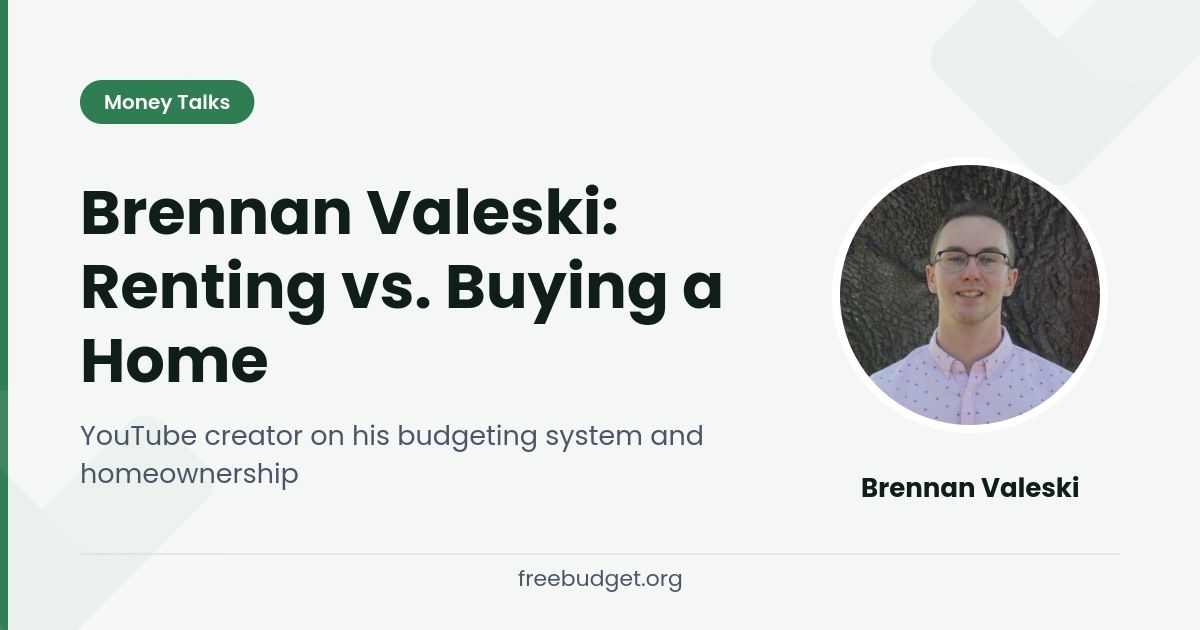
Money Talks with Brennan Valeski: Renting vs. Buying a Home
We're kicking off Money Talks, a new series introducing our audience to creators and coaches across the personal finance space. First up is Brennan Valeski, who covers personal finance, business, and the financial products people use every day across YouTube, Instagram, and TikTok. Here's our conversation with him.
Tell us a little about yourself and your story. How did you get into the personal finance space?
Like many people, I first became interested in personal finance when I started earning a little money around age 16 or 17 and wanted to understand what to do with it. My parents and family had always taught me the importance of saving, but that naturally led to more questions: Save it where? Should I invest it? How do I actually make my money grow?
Around 2015, I wanted to start buying stocks, but I was hesitant to pay roughly $7 per trade through Scottrade, the brokerage my grandfather used, which no longer exists today. Through early personal finance creators on YouTube, including Jeremy from Financial Education and Graham Stephan, I discovered Robinhood. Being able to invest commission-free was a major benefit at the time.
Over the years, that interest grew into a desire to create similar content about personal finance, business, and the financial products people use every day. I already had experience making gaming videos on YouTube as a teenager, so creating educational finance content felt like a natural next step.
What does your own budgeting system look like day-to-day? Do you use any tools, spreadsheets, apps?
My budgeting system is a combination of a few apps and some flexible guidelines. I use Monarch to sync all of my accounts into one dashboard, which makes it easy to monitor transactions, balances, and overall cash flow.
I do not follow a strict written budget, but I have general spending ranges for different categories and have built strong enough habits to usually stay within them. I review my spending periodically to see how I am doing month to month and year to year and to catch any areas where expenses may be creeping up.
For larger upcoming purchases, I adjust as needed. I might invest a little less that month and leave more cash in my checking account so the expense is already covered when the bill arrives. Overall, my approach is flexible and cash-flow-based rather than built around rigid monthly limits.
There's a lot of conflicting personal finance advice online. What's one piece of conventional wisdom you've pushed back on or changed your mind about?
One piece of conventional wisdom I have pushed back on is that buying a home is always the smartest financial decision. A lot depends on market conditions, and a home is usually the largest asset someone will ever purchase. Unlike investing in the stock market, where you can gradually buy in over time, purchasing a home is one large decision made at a particular price and interest rate. That timing can work strongly in your favor—or against you.
I bought my home in 2022, and after roughly four years, its estimated value is about $4,500 lower than what I paid. I have also spent around $7,500 on repairs, maintenance, and other home-related expenses. Although I have paid down approximately $20,000 of the mortgage and built equity, that equity has primarily come from my own payments rather than appreciation.
My 3.875% interest rate has been the saving grace because my monthly payment is lower than what the same property would likely rent for today. However, I have also seen peers prioritize buying because conventional wisdom told them it was the responsible next step, only to purchase at high prices with high interest rates and end up paying substantially more than they would have to rent.
I am still glad to own my home and value the stability and control it provides. But I no longer believe buying is automatically better than renting. Homeownership can be a good lifestyle choice and a strong financial decision under the right conditions, but the price, interest rate, maintenance costs, local rental market, and timing all matter.
If someone comes to you completely overwhelmed, debt, no savings, not sure where to start, what's the first thing you tell them to do?
First, breathe. Feeling overwhelmed often makes the situation seem less manageable than it really is, so the first step is to get everything out of your head and onto paper.
Write down every debt you have, from the smallest balance to the largest, along with the interest rate and minimum payment for each one. Then write down your monthly take-home income and your essential expenses, including housing, food, utilities, transportation, and insurance. What remains is the amount you can realistically put toward the debt.
From there, temporarily cut out anything you do not truly need and focus on stopping the debt from growing. If most of the balance is on high-interest credit cards, a 0% balance-transfer card may help reduce the interest while you pay it down, provided you qualify, account for any transfer fee, and have a plan to repay it before the promotional period ends.
The biggest priority is paying down the high-interest debt because compound interest is working against you. Once you can clearly see the numbers and have a specific amount to put toward the balances each month, the situation usually starts to feel much more manageable.
What's next for you, in your business, your finances, or both?
On the business side, I am focusing more on short-form content. For the longest time, I have primarily created long-form videos on YouTube, so I am excited to experiment with new formats and reach people who may not yet be watching longer content.
Personally, my wife and I are looking forward to traveling more and using the credit card rewards points and airline miles we have earned to make those trips possible. Over the next few years, we are also thinking about starting a family, so a lot of my financial planning is centered on continuing to grow the business while building a flexible and secure foundation for that next chapter.
Where can people follow you, find your content, or work with you?
YouTube: https://www.youtube.com/@BrennanValeski
Instagram: https://www.instagram.com/brennan_valeski
TikTok: https://www.tiktok.com/@brennan_valeski
Bonus: something that would surprise your followers
Something that might surprise my followers is that I am a huge cinephile. I have watched and logged more than 1,350 movies, so when I am not talking about personal finance or working on my business, there is a good chance I am watching a film or looking for the next one to add to my list.