What Percentage of Income Actually Goes to Housing in 2026?
 The FreeBudget Team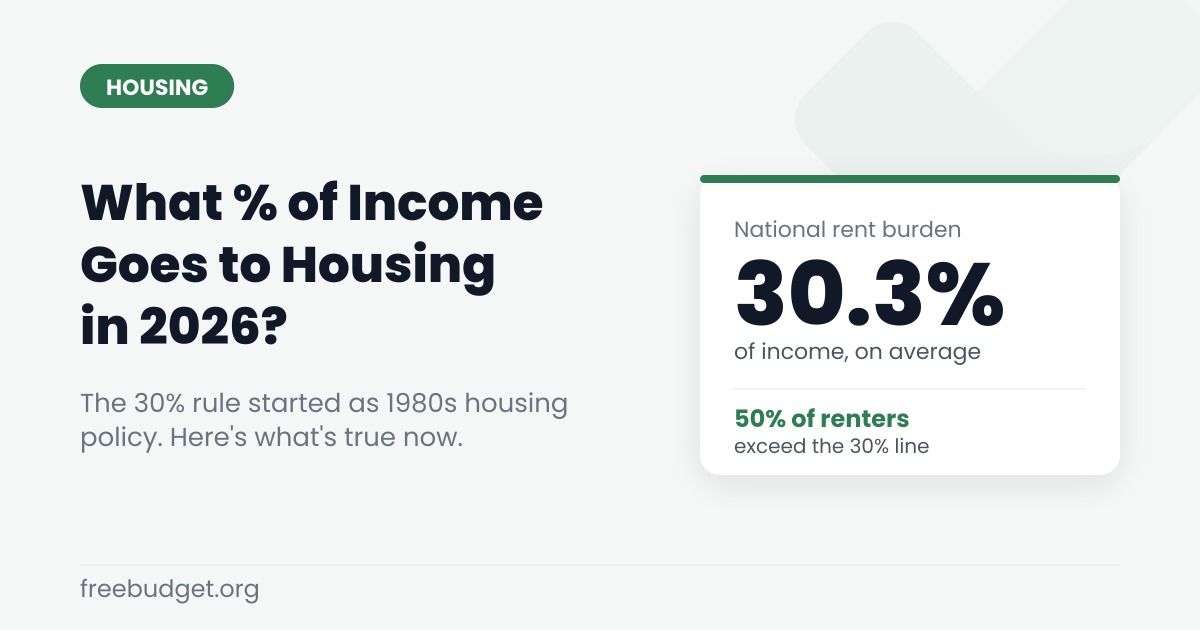
The 30% rule for housing feels like a law of nature. Spend more than 30% of your income on rent or a mortgage and you've done something wrong. Stay under it and you're fine.
It's not a law of nature. It's not even an economic formula. It's a number that came out of a 1969 amendment to a public housing bill, named after the senator who wrote it, and it was never meant to describe your budget or mine.
Where the 30% rule actually came from
Before there was a 30% rule, there was a much cruder one: a week's wages for a month's rent. Housing reformers used that rough guideline going back to the late 1800s and through the Great Depression to figure out which working class families were being crushed by rent. A week's wages out of a month's pay works out to roughly 23%, close to the 20 to 25% threshold those early studies actually used.
That folk rule eventually made its way into federal policy. In 1969, Senator Edward Brooke, the first popularly elected Black senator in U.S. history, wrote an amendment capping what tenants in public housing could be charged as a percentage of their income. The number moved around over the next decade, and in 1981 HUD settled on 30% as the standard. The Cranston-Gonzalez National Affordable Housing Act made it official in 1990, defining any household spending more than 30% of income on housing as "cost burdened."
So the number everyone treats as a universal budgeting rule was actually a threshold for who qualifies for public housing assistance. It was built for a specific government program in a specific decade, not handed down as the correct answer for every renter, buyer, city, and income bracket in the country, forever.
Nobody sat down and ran the numbers on grocery prices, transportation costs, or how many kids the average household had before landing on 30%. It was a policy line drawn to decide who needed a subsidy, and it stuck around because it's simple, memorable, and easy to repeat in an article. That doesn't make it useless. It makes it worth checking against reality every few years instead of treating it as gospel.
What people are actually spending in 2026
Whatever its origins, the 30% line has become the number everyone measures themselves against. So how are people actually doing against it?
The average American household spends about $2,188 a month, or roughly $26,266 a year, on housing. Against average household earnings of just over $104,000, that works out to about 25.2% of income, technically under the line.
Renters specifically are not doing as well. Renter households spent about 32.8% of their income on rent in 2024, and the median U.S. rent works out to 29.1% of median renter household income. National rent burden, a slightly broader measure, averages 30.3%. In other words, the typical renter in America is sitting right at, or just over, the exact line that was supposed to mark financial distress.
And a huge number of renters are well past it. Harvard's Joint Center for Housing Studies found 22.4 million U.S. households spend more than 30% of income on rent, and 12.1 million spend more than half their income on it. Their most recent report puts it even more starkly: 50% of all renter households nationwide, a record 22.6 million people, were cost burdened, meaning they were spending more than 30% of income on housing and utilities combined.
The gap between renters and owners is significant, too. Roughly 49% of renter households exceed the 30% threshold, compared to about 23% of homeowner households. Owning isn't a guarantee of comfort, but the math is clearly worse if you're renting right now.
Why hitting 30% keeps getting harder
This isn't just a feeling. Since 2019, rents nationally have climbed about 34%, while wages grew roughly 27% over the same stretch, and in cities like New York, Boston, and Cincinnati rent has grown up to three times faster than pay. Zoom out further and it's worse: rent prices grew more than six times faster than real median household income between 2000 and 2022.
That gap compounds every year it exists. A rule built in 1981, when rent and wages moved together far more closely, doesn't automatically still fit a market where one has been quietly outrunning the other for two decades. The number on the calculator hasn't changed. The math feeding into it has.
The national average hides the real story
All of these numbers are national averages, which means they flatten out something important: where you live changes this equation more than almost anything else.
Rent-to-income rankings from WalletHub consistently put cities like Miami, New York, and Los Angeles among the least affordable rental markets in the country, places where finding anything close to the 30% line, let alone the older 25% standard, is close to impossible even on a good salary. In some smaller or lower cost metros, renters are landing closer to 15 to 17% of income, less than half the national rent burden. A single 30% number was always going to struggle to describe both of those realities at once, and in 2026 the gap between them is wider than it's ever been.
Half of renters are already "breaking the rule"
Sit with that for a second. The 30% line was originally drawn to identify the households in crisis, the ones who needed help. Today, that's not a small, struggling minority. It's half of everyone who rents.
When a rule of thumb designed to flag the exception becomes true for half the population, the rule hasn't gotten stricter. The math underneath it changed. Rent has grown faster than income in most metro areas for years, and a threshold built in 1981 doesn't automatically keep up with 2026 rents just because it's still printed in every personal finance article.
Does the 30% rule still make sense?
Housing economists have been asking this question for a while now, and the honest answer is: sort of, but not the way most people use it.
The 30% rule treats every dollar of income the same, whether you make $35,000 a year or $250,000. A household earning $35,000 spending 30% on rent has $24,500 left for everything else, food, transportation, insurance, debt, saving. A household earning $250,000 spending 30% has $175,000 left. The rule flags both as "fine" and both as "cost burdened" at the same percentage, even though the lived experience of those two numbers is nothing alike.
That's the real flaw. 30% isn't wrong exactly, it's just too blunt to be useful as a personal target. It was built as a population-level screening tool for a government program, and it got repurposed into individual financial advice it was never designed to give.
What actually matters more than hitting 30%
The useful version of this isn't "stay under 30%." It's knowing your actual number and what's left over after it, because that's the part the 30% rule never tells you.
Two people can both be at exactly 30% and be in completely different financial positions depending on what their remaining 70% has to cover: how much debt they're carrying, whether they have kids, whether they have any savings cushion at all. The percentage is a headline. The number that actually matters is what's sitting in your account after rent, bills, and everything else clears.
If you're already over the line
Being above 30% doesn't mean you did something wrong, especially given that half of renters are in the same position. A few things actually move the needle when housing is already eating more than you'd like:
- Look at total housing cost, not just rent or mortgage. Utilities, renter's or homeowner's insurance, and parking or HOA fees often push the real number several points higher than the number on the lease.
- Check the other 70% before assuming rent is the only problem. A $200 subscription habit or a car payment that's too aggressive can matter just as much as the housing number itself.
- Treat the percentage as a trend to track, not a pass or fail grade. A number that's improving because income is rising is a very different situation than one that's stuck because rent keeps climbing.
- If a move is even a possibility, run the real math on a lower rent in a nearby area before assuming the savings are marginal. A few hundred dollars a month is real money over a year.
None of that requires hitting exactly 30%. It requires knowing your actual number, instead of just assuming you're roughly fine because you've never sat down and calculated it.
That's the whole reason budgeting tools exist in the first place, not to tell you a percentage is bad, but to show you exactly where the rest of your money is actually going once housing takes its cut. We built FreeBudget free because that number shouldn't be locked behind a subscription. Categorizing your spending, seeing your real housing percentage against your real income, and tracking what's actually left every month costs nothing.