How to Make a Holiday Budget in 2026 (Before December Makes One for You)
 The FreeBudget Team
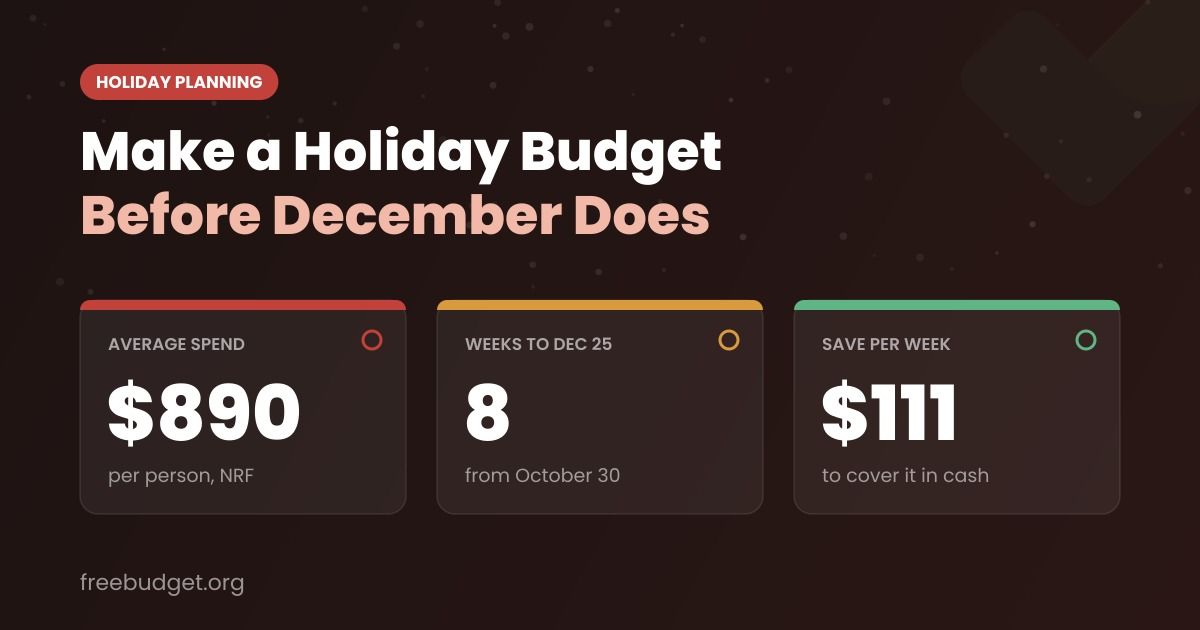
Last holiday season, the average American planned to spend $890.49 on gifts, food, decorations, and cards, according to the National Retail Federation. That was the second-highest figure in the survey's 23-year history.
Then January showed up. LendingTree found that 37% of people took on holiday debt, averaging $1,223, and 40% of them were carrying it at interest rates of 20% or higher.
Here's what's interesting about those two numbers together. Almost nobody decides to go $1,223 into debt for the holidays. It happens in small, reasonable-feeling pieces over about six weeks. That's exactly why a holiday budget works best when you make it now, in October, while December is still a planning problem instead of a spending problem.
This guide walks through how to build a holiday budget that actually survives the season, with real numbers and no guilt.
Why the holidays blow up budgets that work the rest of the year
Most budgets are built around a normal month. Rent, groceries, gas, subscriptions. The holidays break that model in three ways.
The costs are spread across categories you don't usually watch. Gifts are the obvious one, but the NRF breakdown shows that only $627.93 of that $890 was gifts. The other $262.56 went to food, candy, decorations, and cards. Then there's the stuff the survey doesn't count at all: travel, a holiday party outfit, the office gift exchange, extra takeout because everyone's busy.
The decisions are small and emotional. Nobody agonizes over a $40 gift. But twenty-two $40 decisions, each made in a slightly festive mood, is $880.
Everything lands at once. A normal month has one or two irregular costs. December can have fifteen.
A holiday budget isn't about spending less. It's about deciding the total once, calmly, instead of letting it get decided for you one checkout at a time.
Step 1: Find out what last year actually cost
Before you set a number for this year, find out what last year's number really was. Not what you think you spent. What you spent.
Pull up your bank and credit card statements from November and December last year and add up everything holiday-related: gifts, travel, food for gatherings, decorations, shipping, the whole list. If you track your spending in an app, filter those two months by category and you'll have it in a few minutes.
Most people are surprised by this number, usually upward. That's the point. It's much easier to plan around a real number than an optimistic one.
Step 2: Set one total number first
Here's the most important rule in holiday budgeting: pick the total before you pick the gifts.
The instinct is to build the budget bottom-up. List everyone, guess a price for each, add it up. The problem is that bottom-up lists always grow. You remember a coworker, a neighbor, the teacher, the cousin who's coming this year after all.
Top-down works better. Decide what the whole season can cost, then divide it. A few ways to land on a sensible total:
- What you can pay in cash by January 31. If you'd need to carry a balance to afford it, the number is too high.
- Last year's real number, adjusted. If last year was $1,400 and it hurt, try $1,100.
- A share of your monthly take-home pay. If your paycheck is $4,000 a month, a holiday budget of $800 to $1,000 is roughly one week's pay spread across the season.
There's no correct number. There's just the number you choose on purpose versus the one you discover in January.
Step 3: Split the total into categories
Once you have a total, break it into the categories where the money actually goes. A starting template:
- Gifts: around 60 to 70% of the total
- Food and hosting: 10 to 15%
- Travel: whatever it really costs, and often the biggest surprise
- Decorations and cards: 5%
- Giving and donations: if that matters to you, give it its own line so it doesn't get squeezed
- Buffer: 5 to 10% for the thing you forgot
The buffer is not optional. There is always a thing you forgot. Giving it a line in advance means it doesn't wreck the rest of the plan when it shows up.
Step 4: Make the gift list, with a number next to every name
Now list everyone you're buying for and assign each person a number that fits inside your gift category. Not a gift yet. A number.
A few things that make this easier:
- Group people by tier. Immediate family, close friends, extended family, coworkers and others. Give each tier a price range.
- Count the "small" gifts too. Teachers, mail carrier, the Secret Santa at work, hostess gifts. These add up fast and rarely make it onto the first draft of the list.
- Include shipping. If you're mailing gifts across the country, shipping can add 10 to 20% to the cost.
When the list total is bigger than the category, you have a decision to make now, in October, instead of at the register in December. That's the whole advantage of doing this early.
Step 5: Spread the cost across the months you have left
This is where starting in October pays off. If your holiday total is $890, the national average, here's what that looks like depending on when you start:
- Starting in October: about $297 a month for three months
- Starting in November: about $445 a month for two months
- Starting in December: $890 in one month, on top of normal December bills
Setting money aside monthly, in a separate savings account or a dedicated budget category, turns the holidays from a surprise into a scheduled expense. People sometimes call this a sinking fund. It's the same idea as saving for car registration or an annual subscription: a predictable cost you pay for in advance instead of all at once.
Next year, you can take this even further. $890 divided by twelve is about $74 a month. Starting in January makes the holidays feel almost free by the time they arrive, because the money's already sitting there.
Step 6: Track it while it's happening
The budget you make in October is only useful if you check it in December. This is where most holiday budgets quietly die. The plan exists, but nobody looks at it after Thanksgiving.
A few habits that help:
- Log gifts as you buy them. A note on your phone works. So does a dedicated "Holidays" category in your budgeting app.
- Check the total once a week. Ten seconds on a Sunday is enough to catch drift before it becomes debt.
- Watch the small categories. Food, wrapping paper, and shipping are where overspending hides, because none of them feel like "holiday spending" at the time.
If you use a budgeting app, create a temporary Holidays category with your total as its budget. Everything seasonal goes there. At any point in December you'll know exactly how much you have left, which is a surprisingly calming thing to know in the middle of a crowded store.
What if you've already overspent?
It happens. If it's mid-December and you're past your number, a few honest options:
- Stop and re-plan instead of giving up. Blowing the budget by $100 isn't the same as abandoning it. Reset the remaining categories and keep tracking.
- Swap some gifts for time or effort. A homemade meal, a handwritten letter, or an experience you share together can mean more than one more item in a box.
- Have the conversation. Suggest a family gift exchange or a spending limit for next year. You're rarely the only one who wants one.
- Make a January payoff plan. If it did end up on a credit card, the math is worth knowing. The average $1,223 holiday balance at 22% APR takes about 14 months to pay off at $100 a month and costs around $174 in interest. At $50 a month, it takes almost three years and costs about $415. Paying it down fast is the cheapest option by far. If you have balances on more than one card, our guide to debt avalanche vs debt snowball can help you decide which to tackle first.
The holiday budget in one paragraph
Look up what last year really cost. Pick one total you could pay off by January 31. Split it into gifts, food, travel, decorations, and a buffer. Give every person on your list a number before you shop. Divide the total by the months you have left and set that aside now. Check it once a week until New Year's.
That's it. The math isn't complicated. The only hard part is doing it in October instead of discovering it in January.
Frequently asked questions
How much does the average person spend on the holidays?
The NRF's 2025 survey found Americans planned to spend $890.49 on average, including $627.93 on gifts and $262.56 on food, decorations, cards, and other seasonal items.
How much should I budget for Christmas gifts?
There's no universal number. A good rule is that the full season, gifts included, should cost no more than you could pay in cash by the end of January. Gifts typically make up 60 to 70% of a holiday budget.
When should I start a holiday budget?
As early as possible. Starting in October lets you spread the cost over three months. Starting in January lets you save about $74 a month for an $890 season.
How do I avoid holiday debt?
Set a total before you shop, save toward it monthly, and track spending weekly during the season. LendingTree found 37% of people took on holiday debt last year, averaging $1,223, and most of it came from lots of small purchases rather than one big one.
You can build a holiday budget in a spreadsheet, on paper, or in any app you like. If you want one that shows your holiday spending next to everything else in real time, FreeBudget is free to use for budgets, categories, and reports, and it takes about five minutes to set up at freebudget.org.